Gran Canaria still hides corners that have kept their wild spirit. One of the most striking is Güi Güi Beach, a remote sweep of sand on the island’s west coast, within the municipality of La Aldea de San Nicolás. Travellers looking to switch off from the bustle find an untouched landscape here, far from conventional tourism. How do you get to Güi Güi Beach? Below you’ll find the most accessible options – by sea or on foot.
Where is Güi Güi beach?
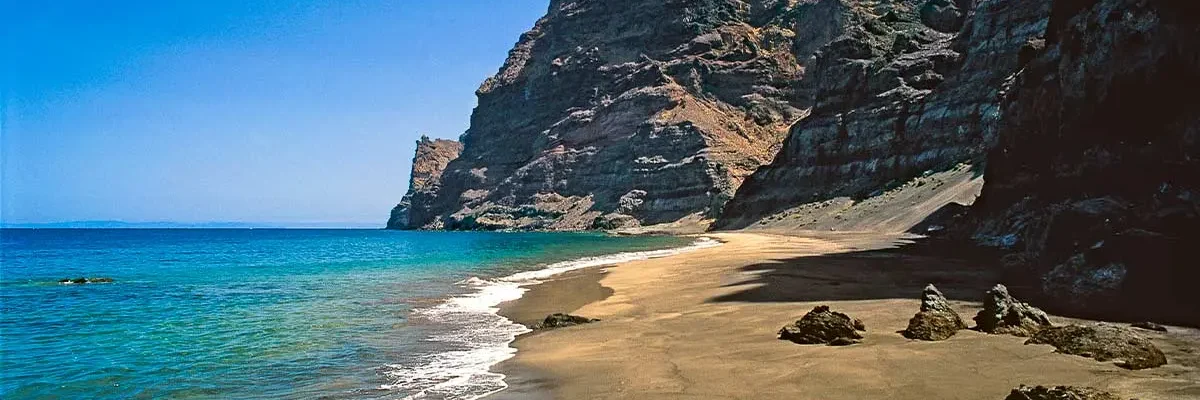
Güi Güi Beach, also known as Guguy or Güy-güy, lies within a Special Nature Reserve. Its difficult access has kept it virtually untouched: no buildings, no services, no crowds. Facing the Atlantic and ringed by volcanic cliffs, it offers a natural environment of high ecological and scenic value.
Why Güi Güi is a Special Nature Reserve
Beyond its rugged beauty, Güi Güi forms part of a Special Nature Reserve because of its ecological importance. This coastal enclave belongs to a fragile, singular ecosystem where volcanic geology, endemic biodiversity and an unusually high level of conservation in the Canaries all come together.
The surrounding vegetation comprises species adapted to arid conditions, such as cardón cacti, tabaibas and verodes. It is also home to protected seabirds, including Bulwer’s petrel, and endemic reptiles like the Gran Canaria giant lizard. The beach itself, free of buildings and services, has stayed pristine thanks to its isolation.
For all these reasons, Güi Güi is not only ideal for those seeking disconnection; it is also a model of well-preserved coastline. Visiting means keeping your impact to a minimum: take everything back with you, leave no trace and stick to established paths.
Güi Güi is a natural enclave, almost untouched. Its remoteness is part of the appeal, though it comes with a few practical considerations worth noting before you go:
- No services or mobile coverage: there are no bars, beach kiosks, lifeguards or signal. Prepare for all needs in advance.
- Protected area: as it sits within a Special Nature Reserve, there’s no infrastructure. Respect the environment, don’t leave rubbish and avoid disturbing the local ecosystem.
- What to bring: food, plenty of water, sun protection and shade (umbrella or hat). There are no fountains or supply points.
- Two distinct coves: the beach is split into Güi Güi Grande, the larger stretch, and Güi Güi Chico, smaller and slightly more sheltered. Both are accessible and share the same wild feel.
How to get to Güi Güi: the main options
There are two usual ways to reach this beach: by boat or on foot. Both take a little planning, but the reward is well worth it.
Reaching Güi Güi Beach by boat
Arriving by sea is a comfortable option, especially in hot weather or if you’d rather skip the hike. From La Aldea, Tasarte, Puerto de Mogán or Puerto Rico, boats trace the south-west coastline to this hidden bay.
You’ll find boat-taxi services and organised excursions that cruise past cliffs and coves before dropping you at Güi Güi. Depending on the season, sea conditions can affect schedules, so check times before you go. If you’d like to discover this stretch of coast from the water, there are several trips that adapt to ocean conditions and take you straight to one of Gran Canaria’s most off-the-beaten-track beaches.
Hiking to Güi Güi Beach
For walkers, the starting point is the hamlet of Tasartico. From here, a roughly 5 km out-and-back trail tackles demanding elevation changes. The first section climbs to the Degollada de Aguas Sabinas pass at 546 metres, with spectacular views over the ravine and coastline, before descending to sea level.
The route is well signposted, but sturdy footwear, plenty of water and sun protection are essential. At the end, Güi Güi Beach awaits and, on clear days, you may spot Mount Teide on the horizon.
When is the best time to visit Güi Güi?
The prime window runs from April to October, when the weather is more stable and rain is unlikely. In summer, temperatures can be high, especially around midday. If you’re hiking, avoid the central hours of the day due to exposure and the lack of shade along the path.
Boat excursions depend largely on sea conditions. Winter can bring heavier swells, reducing departures. Always check the forecast and navigation notices to plan a safe visit.
Where to stay for a visit to Güi Güi
Although Güi Güi Beach sits on Gran Canaria’s west coast, staying in the south — in Meloneras, Maspalomas or Playa del Inglés — makes organising the excursion straightforward. From there, roads lead easily to La Aldea or Mogán, common departure points for the beach.
Lopesan offers a wide range of hotels in the area:
- Lopesan Costa Meloneras Resort & Spa and Lopesan Villa del Conde Resort & Thalasso: both on the Meloneras seafront, with direct access to the GC-1 and a full line-up of wellness, dining and premium services.
- Lopesan Baobab Resort: also in Meloneras, with African-inspired design and spacious areas ideal for families.
- Kumara Serenoa by Lopesan Hotels: in Maspalomas’ Campo Internacional, a tranquil option with an Only Adults area.
- Corallium Dunamar by Lopesan Hotels: in Playa del Inglés, perfect for adults seeking rest, healthy cuisine and a laid-back vibe.
All are well placed for visiting Güi Güi while enjoying the comforts of the island’s south. For more ideas, explore the full Lopesan Hotel Group portfolio on Gran Canaria.
Güi Güi isn’t just another beach; it’s a return to the essentials. Getting there — by land or by sea — is already part of the reward. Don’t miss it!