Taíno culture plays a central role in the history of the Dominican Republic because it helps explain what the Caribbean was like before European colonization. Long before Hispaniola appeared on European maps, Taíno communities had developed their own systems of social organization, agriculture, navigation, spirituality and community life across much of the Greater Antilles.
Taíno society was deeply connected to the land. Daily life revolved around cassava farming, conucos, fishing, pottery, trade between islands and a worldview in which zemis, ancestors and natural forces held great importance. Exploring that complexity offers a fuller understanding of the Dominican Republic beyond its modern image as a tourist destination.
The arrival of Europeans caused a profound historical rupture, but Taíno heritage did not disappear completely. It survives in everyday words, foods, farming techniques, objects, stories, place names and symbols that remain part of Dominican identity. The history of Taíno culture is therefore one of memory, loss and cultural continuity.
What was Taíno culture?
The Taíno were one of the main Indigenous peoples of the Caribbean before European contact. They lived on Hispaniola, the island now shared by the Dominican Republic and Haiti, as well as in Puerto Rico and parts of Cuba and Jamaica. Their communities formed part of a broader Indigenous Caribbean network connected through sea routes, interisland trade and shared cultural traditions.
Taíno society was organized into villages known as yucayeques, each led by a cacique. Their economy relied on agriculture, fishing, gathering and trade between communities. Cassava cultivation played a central role, both as a staple food and as the basis for casabe, a thin cassava flatbread that remains part of Dominican culinary tradition.
Taíno culture is essential to understanding the history of the Dominican Republic before colonization and many of the cultural elements that still shape the country today. Its influence can be found in everyday language, place names, archaeological objects, caves with rock art, farming practices and foods that remain part of Caribbean life. It is more than a distant chapter of history. It is a lasting part of Dominican identity.
Daily life, social structure and Taíno beliefs
Agriculture supported much of Taíno life. Conucos provided an organized system for growing cassava, corn, sweet potatoes, peppers, cotton and other plants used for food, textiles and trade. Fishing, gathering and the use of local resources were also important. Tools, pottery vessels, baskets and hammocks formed part of everyday life.
Taíno society included several levels of rank and responsibility. Caciques led their communities, while nitaínos held positions of higher status within the social structure. Behiques served as healers and spiritual leaders, drawing on their knowledge of plants, ceremonies and communication with the spirit world.
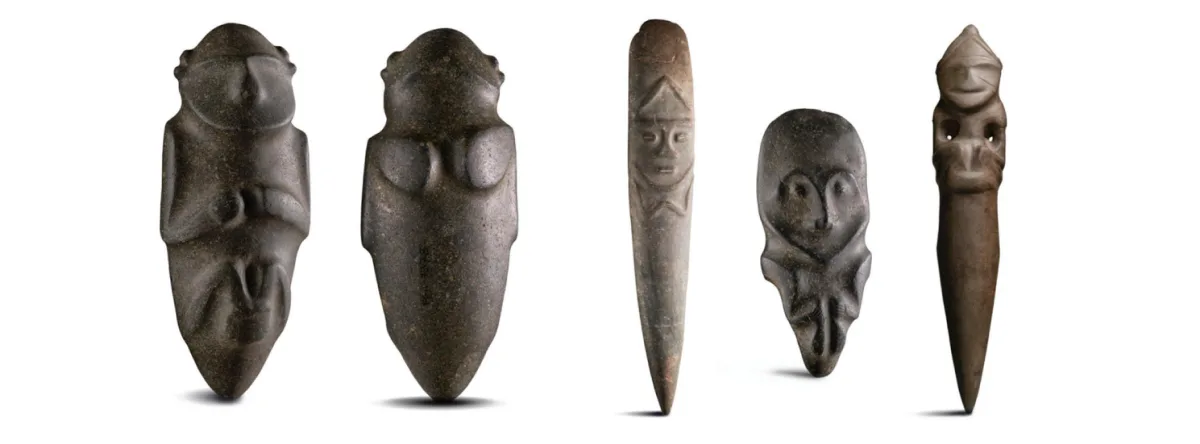
Taíno spirituality was expressed through zemis, sacred figures or objects associated with ancestors, natural forces and the protection of the community. Areítos brought together singing, dancing and oral storytelling. These gatherings helped preserve collective memory, strengthen community ties and pass stories and traditions from one generation to the next.
For the Taíno, everyday life, social organization and spiritual belief were closely connected. Together they shaped the way communities understood themselves and their relationship with the natural world.
European arrival and the collapse of the Taíno world
Christopher Columbus’s arrival on Hispaniola in 1492 marked the beginning of a devastating period for the Taíno people. Initial contact quickly gave way to territorial occupation, control over Indigenous communities and the forced restructuring of their work, social organization and daily lives.
Under the encomienda system, many Taíno people were forced to work under Spanish rule. Violence, displacement and diseases to which Indigenous populations had no prior immunity caused further devastation. Within only a few decades, the Indigenous population of Hispaniola declined dramatically.
This rupture transformed the history of the Dominican Republic. Even so, Taíno heritage did not disappear completely. Elements of it survived in language, food, objects, symbols and the country’s cultural memory.
The Taíno legacy in the Dominican Republic
The Taíno legacy remains present in Dominican life through language, food, crafts and cultural memory. Words such as hamaca, canoa, cacique, huracán, bohío, yuca and maíz come from the Indigenous Caribbean world and remain part of everyday Spanish.
Food preserves another important part of this heritage. Cassava, casabe, corn, sweet potatoes and peppers connect present-day Dominican cuisine with practices that predate colonization. This continuity has been shaped by centuries of change, but it is still visible in ingredients, farming methods and food preparation.
Archaeological objects, pottery, zemis, ceremonial stools known as duhos, petroglyphs and symbolic motifs also survive as part of the Dominican Republic’s cultural heritage. Taíno culture remains present through a history shaped by loss, cultural mixing and reinterpretation.
Taíno words that remain part of Caribbean Spanish
The Taíno legacy also survives in language. Many words that now seem fully integrated into Spanish originated through contact between Europeans and the Indigenous peoples of the Caribbean. Some come directly from Taíno, while others belong more broadly to the Arawakan languages of the Antilles, so their exact origins are sometimes difficult to determine.
The Royal Spanish Academy identifies words such as ají, bohío, canoa, hamaca, maíz and yuca as having Taíno origins.
- Canoa was among the first Indigenous words to appear in written Spanish after European contact with the Caribbean. It described something new to the Spanish: a light boat used on rivers, along coastlines and for travel between islands.
- Hamaca followed a similar path. The word referred to an everyday household item well suited to the Caribbean climate. When the term entered Spanish, it also introduced a specific way of resting that used plant fibers, allowed air to circulate and worked well in hot environments.
- Yuca, maíz and ají entered Spanish through food and agriculture. They were more than names for plants. They referred to staple crops, cooking traditions and foods that played a central role in the Indigenous diet.
- Cacique entered Spanish as the title for an Indigenous leader. Over time, the word developed broader political meanings far removed from its original context.
- Huracán also has a strong connection to the Caribbean environment. The word became the term for powerful tropical storms, a climatic reality Europeans learned to describe through local knowledge.
Where to discover Taíno heritage in the Dominican Republic
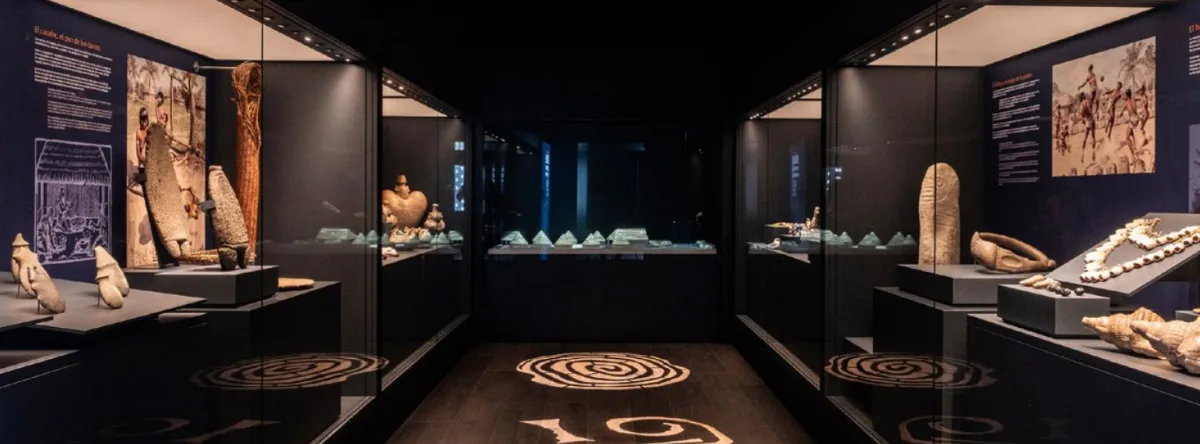
Travelers who want to explore Taíno culture beyond archaeological sites and traces found throughout the country can visit several important cultural institutions. Casa del Cordón, located in Santo Domingo’s Colonial City, is one of the Dominican Republic’s most significant historical and cultural landmarks.
Its exhibitions focus on national history and heritage and include archaeological pieces, ceremonial objects and interpretive materials related to the worldview, beliefs, social structure and artistic traditions of the Taíno peoples who lived on the island before European arrival.
A visit to the capital offers a strong cultural contrast to time spent at the beach. Its museums, monuments and historic spaces provide a fuller understanding of the Dominican Republic’s roots and the Taíno influence that remains visible in Caribbean language, food, traditions and identity.
Experiencing Taíno heritage while traveling through the Dominican Republic
Taíno heritage can be found in museums, caves, archaeological collections and sites with rock art. The Museum of the Dominican Man in Santo Domingo and several caves in Cotubanamá National Park introduce visitors to the Taíno world through pottery, ritual objects, pictographs and petroglyphs.
The Colonial City provides an additional historical context. It preserves the setting where sustained European colonization began on Hispaniola and where the precolonial Indigenous world faced a violent and irreversible break.
For travelers staying in Punta Cana, this cultural dimension gives the trip greater depth. Lopesan hotels in Bávaro Beach can serve as a base for combining time by the ocean with visits and excursions that reveal a broader view of the Dominican Republic, one also shaped by the enduring Taíno legacy. por la huella taína.