The Canary Islands Botanical Garden (Jardín Canario) is the nickname given to the Viera y Clavijo Botanical Garden in Gran Canaria. It was founded in 1952, based on the idea of the Swedish botanist Svensson, with the aim of bringing together in one place all the plant species of the archipelago.
Over the years, thanks to the various directors who have been in charge of it, this space has acquired great scientific and environmental educational importance. Today, it is a space for dissemination and research, housing the facilities of the CSIC and aiming to promote knowledge of the native vegetation of the islands. This article will tell you all about this wonderful place.
What to see in the Canary Islands Botanical Garden
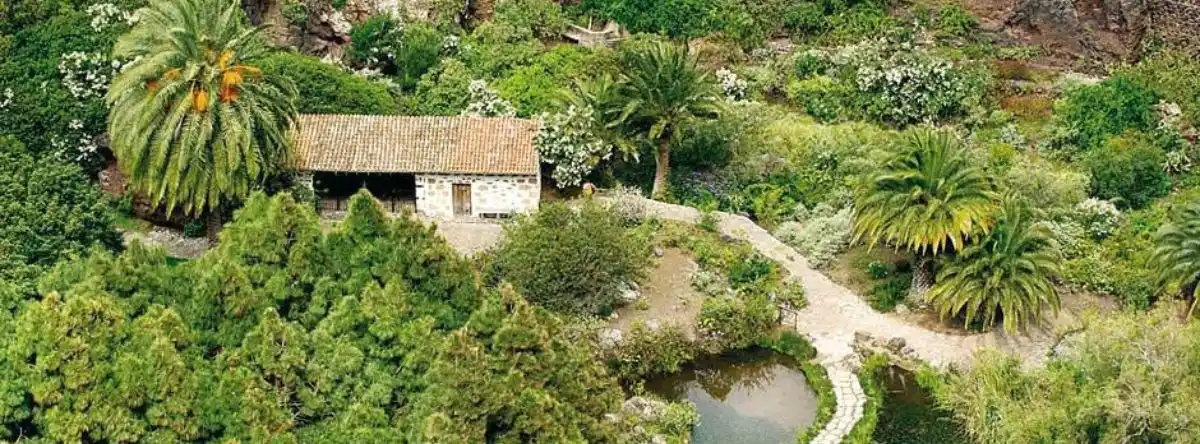
A visit to the Viera y Clavijo Botanical Garden means discovering its 27 hectares, making it the largest in Spain. It is spread over the terraces of the Barranco de Guiniguada ravine, creating a beautiful landscape in itself. It has two entrances, one at the top and the other at the bottom, and along its paths you can discover the following points of interest.
Canarian Garden squares
Throughout the walk, the squares become the central elements of the visit. There are four main squares, each with a different atmosphere:
- Plaza Viera y Clavijo: Named after the priest and botanist who wrote the Diccionario de historia natural de las islas Canarias (Dictionary of Natural History of the Canary Islands). It is a viewpoint from which a large part of the garden can be seen. It is also surrounded by the Canary Island cedar.
- Plaza de las Palmeras: This is the first stop after the entrance to the Dragonal. It is surrounded by indigenous palm trees between 10 and 15 metres high, some of which reach 25 metres.
- Plaza de los Nenúfares: This square has a pond full of water plants. There is also a statue of Svensson.
- Plaza Fernando Navarro: It has the honour of being home to the official plant of Gran Canaria, the Canary Island cactus.
Gardens of the Viera y Clavijo Botanic Garden
The gardens are divided into different areas:
- Succulent garden: With more than 2,000 specimens, it focuses on the island’s species.
- Jardín de las islands: Together with the previous garden and the cactus garden, it completes the collection of island plants.
- Macaronesian ornamental garden: In addition to plants from the archipelago, there are species from Macaronesia (Azores, Madeira, Cape Verde and the Wild Islands).
Jardín of the world: It is home to a collection of species that have arrived on the islands as a result of their role as one of the main points of communication with the Americas.
Other areas of the Canarian Garden
Throughout your visit, you will be able to discover different corners that make this place unique. Its innumerable paths are home to halophytic and rocky vegetation, green bushes and a pine forest. Not forgetting the area dedicated to the Dragon Trees of the World, the flagship plant of the archipelago.
Another stop not to be missed is the Fuente de los Sabios (Fountain of the Wise), a monument in honour of the naturalists and botanists who tried to preserve the islands’ flora and fauna in the face of invasive species. Also visit the Jardín Escondido (Hidden Garden), a small greenhouse that recreates an idyllic tropical environment that many people have left behind.
Practical information about the Viera y Clavijo Botanic Garden
For your visit to the Canary Islands Botanic Garden, it is essential that you have some basic information at hand. This will help you plan your visit and make the most of your day in this unique green space.
Opening hours, prices and guided tours at the Viera y Clavijo Botanical Garden
The first thing you need to know is the opening times and prices for visiting the garden on your own.
Let’s start with the opening hours of the Jardín Canario:
- Monday to Friday (except holidays)
- 07:30 to 19:00 in the summer season (from April to September).
- 07:30 to 18:00 during the winter season (from October to March).
- Saturdays, Sundays and holidays
- 10:00 to 18:00 all year round.
Please note that the last admission is one hour before closing time. In addition, on 24, 25 and 31 December the park is closed all day.
As far as the price of the Jardín Canario is concerned, you are in luck, as it is free of charge. As part of its concept of scientific dissemination, access to the facilities is free for anyone who wants to discover them. Along the route you will find a variety of informative panels that will help you discover the hidden treasures.
You can also take part in free guided tours on weekends and public holidays. All you have to do is fill in the form and wait for confirmation of your place.
Where is the Canarian Garden and how do I get there?
The garden is located at the 7th kilometre of the road to the city centre. Knowing how to get to the Jardín Canario will help you plan your visit.
One of the options is public transport. You can take the bus from the Santa Catalina junction (lines 301 and 323) or from San Telmo station (lines 303, 311 and 302).
Another option is to travel by car. You can use either of the two entrances (Tafira or El Dragonal) and leave your car in either of the two car parks.
Map of the Canarian Garden
You can download a map of the garden to help you navigate around it. Everything will be easier and more comfortable for you and you will be able to get to know every corner of this green space.
When you visit the island of Gran Canaria, the Canarian Garden is one of the places you cannot miss. You can discover the richness of the island’s vegetation for free and enjoy the beautiful landscapes that surround it.
And you still don’t know where to stay? At the Lopesan Hotel Group we offer a wide range of accommodation to suit all tastes.
Enjoy the wonders of Gran Canaria with a visit to the Viera y Clavijo Botanical Garden.