Rügen still carries the sense of exclusivity that European aristocracy gave it when they decided these Baltic beaches were the place to spend their summer. That Prussian legacy shaped the island’s character and is still visible as you move around it: immaculate white façades, palaces hidden in the forest and fishing villages that have barely changed in decades.
This mix of old resort refinement and the straightforward rhythm of northern harbours is what makes Rügen feel unlike a typical German island. It’s a destination with a very particular kind of elegance, where a grand wooden pier can sit beside a fishermen’s shelter with a thatched roof.
Castles and palaces: the mark of the nobility
European aristocracy turned Rügen into a favourite summer address, and the buildings they left behind remain the clearest trace of that world. These estates and pavilions shape the landscape and help you understand how nineteenth-century nobles spent their time here.
Granitz hunting lodge (Jagdschloss Granitz)
This is the most visited monument on Rügen. Its 38-metre tower rises above the treetops and serves as a landmark visible from much of the island. The Putbus family commissioned it on a wooded hill in the mid-19th century, not as a main residence, but as a refined retreat for hunting parties.
Beyond its striking reddish façade, the real highlight is the cast-iron spiral staircase: 154 steps that seem to float against the inner wall of the tower. If heights don’t bother you, the climb is worth it. From the top, the views over the Baltic and the coastline are the best reward. To get here in the most atmospheric way, take the Rasender Roland, a historic steam train that runs through the forest and stops close to the entrance.
Putbus palace
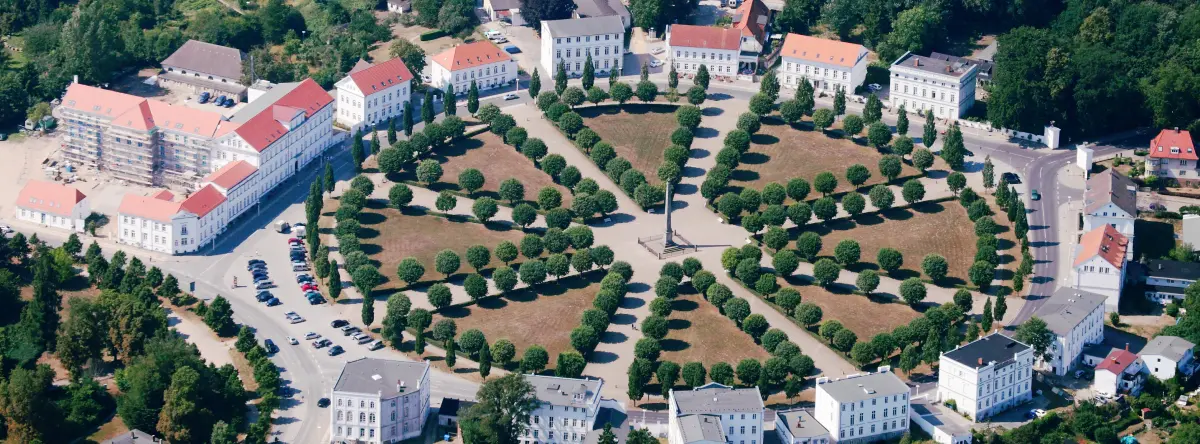
Putbus is known as the “White Town” for the immaculate neoclassical façades that define its streets. Prince Wilhelm Malte I set out to build an ideal town here, and the result is still striking: a carefully planned street layout and a circular square, the Circus, with a symmetry that feels almost unreal. Although the main palace was demolished in the 1960s, the 75-hectare park remains. Here you can walk among centuries-old trees and roaming deer, a quiet way to experience the cultivated atmosphere the Putbus family brought to the town. Don’t miss the Putbus Theatre either, one of the best-preserved historic buildings on the island, still hosting an impressive cultural programme in a setting that feels lifted from another era.
Charming villages and spa architecture
If one style defines the image of Rügen, it is the Bäderarchitektur, or spa resort architecture. You’ll spot it in the white façades, carved wooden balconies and decorative towers that give the seaside towns their distinctive look.
Binz and Sellin
Binz is one of the clearest examples of this elegance. A walk along its main avenue feels like stepping back a century: everything is carefully maintained, and the white façades can be dazzling in bright sun. For the island’s most iconic view, head to Sellin. Its pier, the Seebrücke, reaches out into the sea with a pavilion above the water that looks almost like a floating palace.
The fishing village of Vitt
At the other end of the spectrum, far from the resort glamour, lies Vitt. This small fishing village is tucked into a hollow near Cape Arkona. What makes it special are its thatched cottages, preserved much as they were centuries ago. It’s quiet and compact, and it captures another side of Rügen: the lives of people who have always depended on the sea.
Cape Arkona and its defensive legacy
Rügen was not only a summer retreat; it was also a strategic point for maritime control. This northern tip of the island carries particular historical weight, bringing together the world of navigation and older defensive sites.
The lighthouses and the Slavic fortress of Jaromarsburg
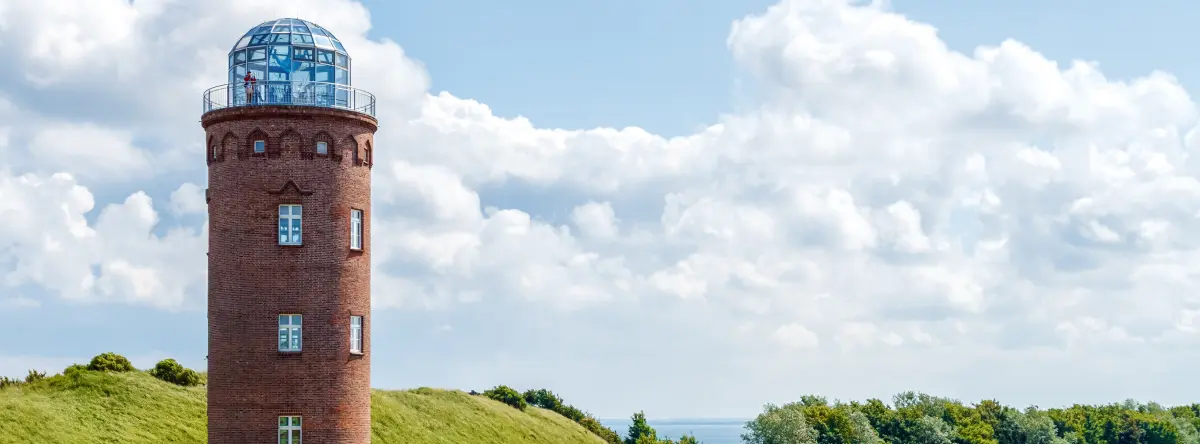
At Cape Arkona, two worlds meet. On one side, the two lighthouses and the signal tower have guided ships along this coast for centuries. Over time, they have become more than navigational aids: they are now defining features of the shoreline. Nearby are the remains of the Jaromarsburg fortress. In the twelfth century, this was the last stronghold of the Slavic tribes, a sacred enclosure dedicated to the god Svantovit. Only the earthworks remain today, but it is easy to picture the cliff-top temple-fortress before it was destroyed.
Prora: the stone colossus of the 20th century
This vast complex is one of the most visible traces of the National Socialist period on the island. It was designed as a holiday resort for thousands of people, with eight identical blocks stretching for several kilometres along the seafront. Although the project was never completed as planned, the concrete structure still stands.
In recent years, parts have been redeveloped into apartments and hotels, while a documentation centre on site explains its origins and preserves the memory of that chapter of German history.
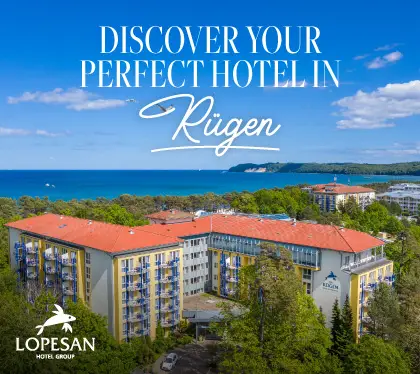
A journey through Rügen’s heritage feels incomplete if your accommodation doesn’t match the island’s sense of calm and understated exclusivity. After palaces and cliffs, it makes sense to return to a place that continues the experience. IFA Rügen Hotel & Ferienpark offers exactly that: a seaside base where the day’s discoveries give way to proper rest.
At Lopesan Hotel Group, that balance is what we focus on: a place to switch off, slow down and take in everything you’ve seen. Our hotels are designed so that comfort and surroundings work together, making your Baltic escape feel, quite simply, complete.