Gran Canaria’s privileged geographical location, close to Africa and in the tropics, makes it an important refuge for migratory birds. This environment offers them an oasis for feeding and resting, with a variety of habitats such as salt marshes, salt pans, natural ponds such as the one in Maspalomas, and reservoirs and ponds scattered throughout the island.
The beauty and uniqueness of Gran Canaria’s bird life is such that it attracts birdwatchers from all over the world. The emblematic canary bird, with its distinctive song and colourful plumage, has become a global icon of avian beauty. The island is also home to a variety of birds of prey, including the common kestrel. Although in decline, scavenging birds such as the Canary Island crow can still be seen, and it is important to remember that Gran Canaria was also home to the Egyptian vulture in the past.
Blue Chaffinch of Gran Canaria
The blue chaffinch, scientifically known as Fringilla teydea, is an endemic bird of the pine forests of the Canary Islands. There are two subspecies: teydea in Tenerife and polatzeki in Gran Canaria. The polatzeki subspecies is critically endangered, mainly due to the threat of forest fires in its habitat.

It is a small species, similar in size to a sparrow, but robust. Males have a short grey bill. The plumage of the Blue Chaffinch is mostly blue, with white feathers on the belly and black feathers on the wings and tail. In the Gran Canaria subspecies, the white bars on the wingtips are conspicuous. In contrast, females and young males have greyish-brown plumage, similar to that of the chaffinch.
It is a gregarious species that can be found together with other species, such as the chaffinch. Its conservation is crucial for the biodiversity and ecological balance of the Canary pine forests, especially in Gran Canaria, where it is critically endangered.
Hoopoe
The hoopoe is recognisable by its crested plumage and peculiar call. Also known as ‘Apupu’ or ‘Tabobo’ (Upupa epops), it is found almost everywhere on the Iberian Peninsula, except in the north, in Cantabria. In the Canary Islands, it is present on all the islands, including La Graciosa.
This peculiar bird measures between 23 and 27 cm in length and has a wingspan of between 44 and 48 cm. Its plumage is sandy with orange and pink tones. Its wide, rounded wings and broad tail have prominent black and white bars. The most striking feature is its long crest, which it can unfold at will and which is ochre with black tips. Its dark bill is long and slightly curved downwards.
The hoopoe’s flight is distinctive, consisting of irregular flapping and gentle undulations. There are no major differences between the sexes, but juveniles have duller plumage.
Kestrel
The kestrel, also known as the common kestrel, belongs to the species Falco tinnunculus canariensis (Koenig, 1890). It is the most abundant and widespread bird of prey in the Canary Islands. There are two subspecies: dacotiae in Lanzarote and Fuerteventura, and canariensis in the rest of the Canary Islands, Madeira and the Salvajes Islands.
It is a small to medium-sized falcon with narrow, pointed wings and tail. Males measure between 31 and 37 centimetres in length and have a wingspan of between 69 and 78 centimetres, while females are slightly larger, as is usual in birds of prey. It has a characteristic plumage: males have a reddish upperparts with black spots, while the underparts are creamy, with a grey head, black stripes on the cheeks and a sort of dark moustache. Females, on the other hand, are browner with more ochre patches on both sides of the body and a less prominent moustache. Juveniles have similar plumage to females.
The subspecies canariensis is slightly smaller, with males having bluish-grey plumage on the head, while females are mostly brown with black barring.
Canary
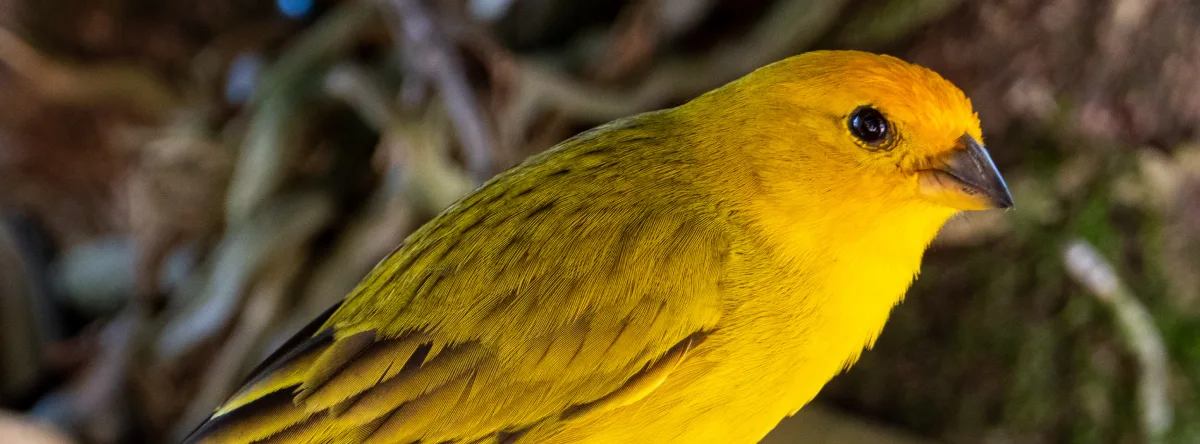
The Canary, also known as the Wild Canary, is a species endemic to the islands of Madeira, the Azores and the Canary Islands, where it is considered the animal symbol of the archipelago. It can be found in almost all the habitats of the islands. It is the ancestor of the domestic Serinus canaria, better known as the cage canary, one of the most popular pet birds in the world.
This small bird, about 13 cm long, has a short bill and brightly coloured plumage. The upperparts and tail are greenish-grey with darker barring, while the underparts are yellow with a white belly. The tail is darker grey than the upperparts and has yellow barring. Males are more conspicuous than females, while young are brownish.
The Canary is mainly sedentary and can live between 5 and 10 years in the wild. One of the most distinctive features of this species is its song, which combines different notes in a melodic way, similar to the chirping of the goldfinch.
Stone Curlew
The Stone Curlew is a small wading bird with large yellow eyes that is easily camouflaged thanks to its discreetly coloured plumage, mainly brownish-earthy, and its elusive and nocturnal nature. Two subspecies endemic to the Canary Islands are present: Burhinus oedicnemus distinctus, which inhabits La Gomera, El Hierro, La Palma, Tenerife and Gran Canaria, and Burhinus oedicnemus insularum, which lives on Lanzarote, Fuerteventura, La Graciosa and Alegranza.
This wading bird is small, with a length of 40-44 cm and a wingspan of 77-85 cm. Its eyes are large and yellow, and its plumage is mostly earthy-brown, with a white stripe with black edges on the wings and two white stripes near the eyes, one above and one below. The bill is yellow with a black tip, and the legs are long and yellow, perfect for running. In young birds, the white stripes on the wings and face are less pronounced. In flight, the underside of the wings is very pale.
Canary Crow
The Canary Crow is a robust bird with a length of about 64 cm and a wingspan of about 120-150 cm. It weighs about 1 kg. It is easily recognised by its black plumage, beak, legs and tail. The plumage is shiny with metallic green to bluish purple highlights. The tail is wedge-shaped and the bill is long, slightly curved and strong. The legs are also robust.
It is a subspecies (Corvus corax canariensis) of the larger species of the corvid family. It is found on all the islands of the Canary Archipelago, although its numbers are declining. Its presence is of great importance to the ecosystem of the Canary Islands, although its population is declining and its conservation is a matter of concern.
Cory’s Shearwater
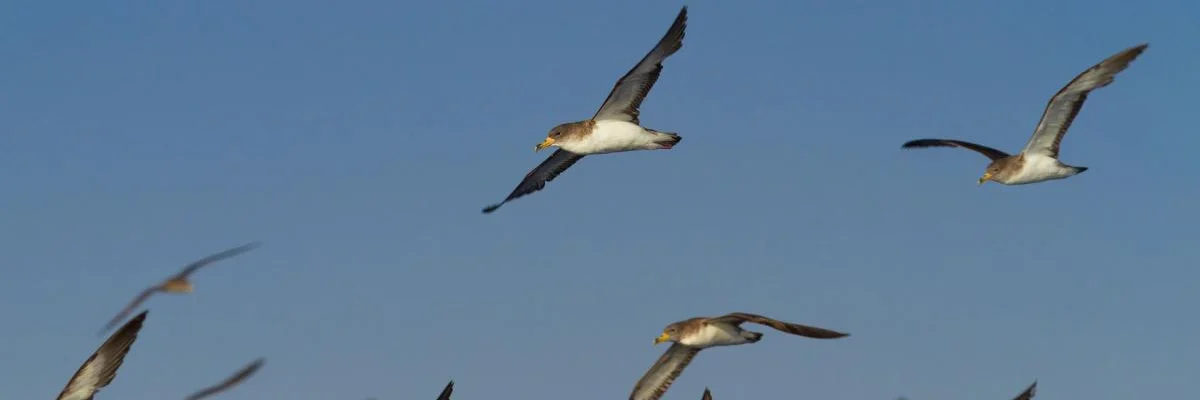
In the Canary Islands, the Cory’s shearwater is represented by the subspecies borealis. This subspecies is also threatened, although its conservation status is considered vulnerable rather than endangered, as is the case with the Mediterranean subspecies.
The Cory’s Shearwater borealis is a large marine bird with a wingspan of about 120-125 cm and a length of 45-56 cm. Its plumage is greyish-brown on the upperparts and white underparts, with the outer edge of the wings dark. Its wings are long and narrow and its bill is yellowish with a black tip.
It is a long-lived species, reaching sexual maturity at around 3 years of age and generally breeding between 4 and 6 years of age. In the Canary Islands, the Cory’s shearwater is an important part of the marine ecosystem and its conservation is crucial to maintaining the biodiversity and ecological balance of the region.
The birds of Gran Canaria are a spectacle for any nature lover. Observing and photographing them can be a reason to organise your holidays, so we recommend that you look for accommodation in Gran Canaria that offers you the comfort and amenities you are looking for. At the Lopesan Hotel Group we offer you all the services and luxury you deserve. Give us a call!