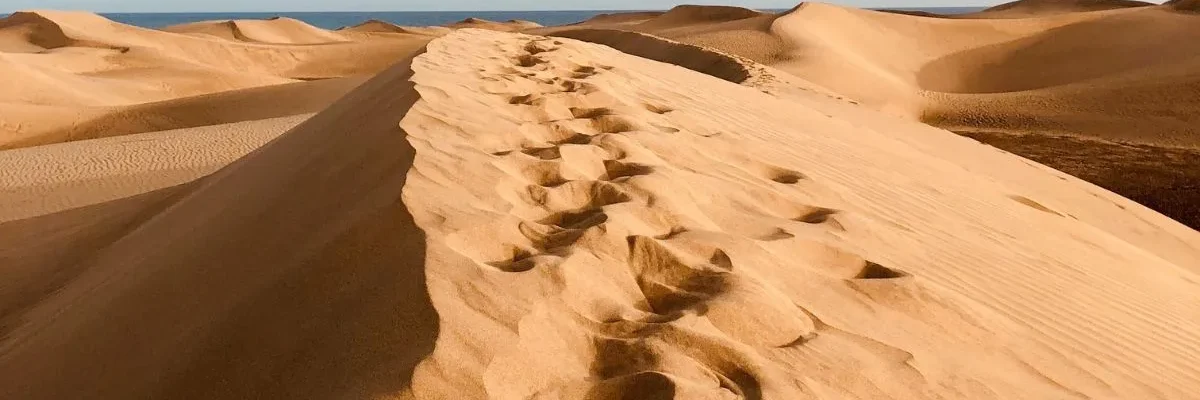
Gran Canaria is a unique place in many ways, but there is one feature that attracts thousands of tourists every year: the Maspalomas Dunes. With many secrets behind their formation, these dunes are the result of a perfect process of sedimentation and erosion. In this article, we’ll explore the facts and curiosities of the Maspalomas Dunes.
If you’re thinking about traveling soon to Gran Canaria and don’t want to miss a spectacular landscape while enjoying everything nature has to offer, then this article is for you. Keep reading to discover what Maspalomas and its famous dunes have in store for you.
Do you know all the secrets and mysteries of the famous Maspalomas Dunes?
There are many secrets hidden within this spectacular formation. Here we’ll go over some of them, full of fascinating details, history, and insight into nature.
The secret behind the formation of the dunes
How were the Maspalomas Dunes formed? The dunes we can enjoy in this area are made up of sediments. These come from the decomposition of marine organisms such as algae or shells, as well as from the erosion of volcanic rocks. However, the process is not that simple. Ocean currents carry these sediments to the coast, and the wind is the factor that moves them inland.
Once the wind moves them, certain types of vegetation help these sediments accumulate and form small mounds, which grow as the vegetation that holds them expands and the wind continues to bring more material.
Another hypothesis about the formation of the Maspalomas Dunes is the tsunami caused by the Lisbon earthquake 266 years ago. According to this theory, supported by researchers from the University of Las Palmas de Gran Canaria (ULPGC), there is scientific evidence that the dunes did not exist before the year 1800, meaning they were not formed as long ago as previously believed. This contradicts the earlier theory that suggested a slow formation process over approximately 10,000 years. This theory is explained in the article “Tsunami, the origin of the Maspalomas Dunes”.
Home to many native and migratory species
The Maspalomas Dunes are a unique place in Gran Canaria. They have been a protected natural area since 1994. Across their 400 hectares, you can find numerous protected species, including hoopoes, turnstones, egrets, moorhens, parrots, curlews, sanderlings, plovers, stilts, doves, and shrikes. There is also a significant reptile population, such as the Gran Canaria giant lizard.
A natural reserve and protected area
As mentioned earlier, this has been a protected area for nearly three decades. The vegetation consists of rare species that especially attract visitors who love nature and, above all, botany. Known as the Maspalomas Dunes Special Nature Reserve, it has outstanding botanical, aesthetic, and wildlife value.
In addition to fauna, the Maspalomas geosystem allows important plant species to thrive, such as aulaga, balancón, bare sedge, tamarisk, rush, and Phoenix canariensis, among others.
It supplied Columbus with water and wood
Although there are different versions of events, many historians such as Antonio Romeu de Armas, Francisco Morales Padrón, and Alejandro Cioranescu claim that Christopher Columbus supplied himself with water (from the lagoon) and wood from this area of Maspalomas. This is also explained by writer Alfredo Herrera Piqué in the book Las Palmas de Gran Canaria: Patrimonio histórico y cultural de una ciudad atlántica. According to this account, Columbus made this stop—the last one—before leaving Gran Canaria and beginning his journey to the New World.
The dunes hide a small oasis
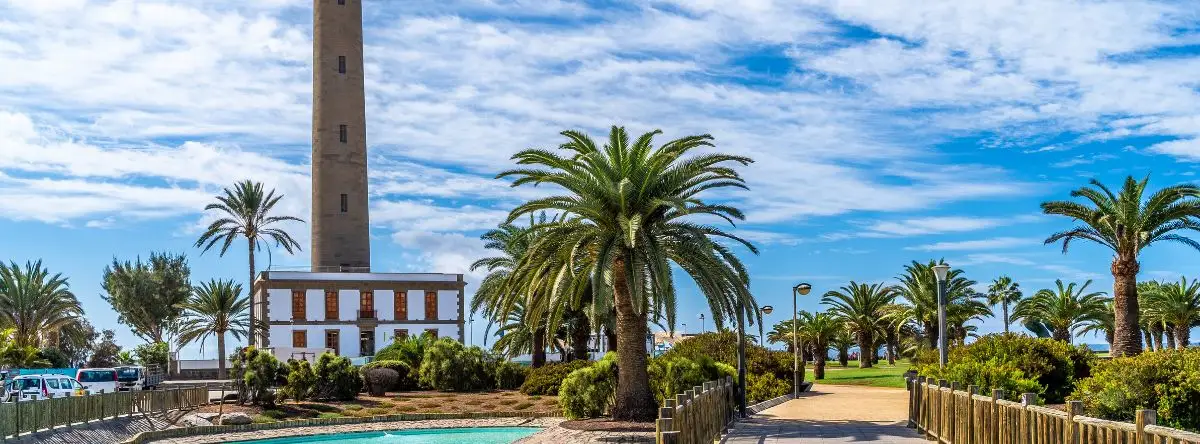
Within what may seem like a lonely dune landscape, and just 200 meters from the Maspalomas Lighthouse, there is a saltwater lagoon that forms part of an oasis in the middle of the sand. It is surrounded by numerous birds, where many native and migratory species gather in search of insects and fish. Without a doubt, a true oasis that enhances the beauty of this unique sandy environment.
There is a lighthouse over 120 years old here
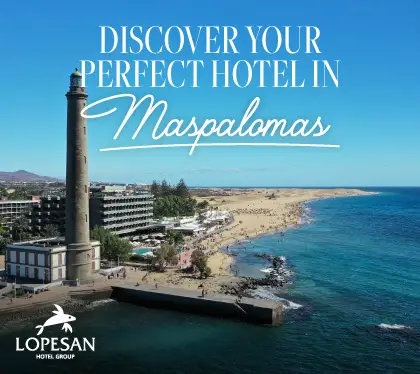
A symbol of the Canary Islands, the Maspalomas Lighthouse has witnessed how this area has developed into a major tourist destination. Surrounded by dunes, its history dates back to 1861, when the idea of building it first arose. However, it was not inaugurated until 1890. It has a diameter of 6.20 meters and a height of 55 meters. Its light reaches up to 35 kilometers. Today, the lighthouse is more of a museum feature than a navigational reference.
Want to stay next to this natural wonder?
If you’re thinking about spending a few days enjoying this natural wonder in Gran Canaria, we recommend staying in one of the hotels offered by Lopesan Hotel Group (link). Thousands of tourists choose this option every year.
Lopesan Hotels in Maspalomas
There are several hotels that are ideal for your stay near the dunes and, of course, the oasis of this unique destination.
- Hotel Faro, a Lopesan Collection Hotel: A five-star hotel with a prime location between the dunes and the sea. From your room’s balcony, you can enjoy breathtaking views of the coastline. If relaxation isn’t your only goal, there are plenty of leisure activities available both inside and outside the hotel. Its gastronomy is also a delight for all five senses.
- Kumara Serenoa By Lopesan Hotels: A four-star hotel located in the triangle formed by the beach, the Maspalomas golf course, and the dunes park. Its location is unbeatable, with plenty of entertainment options nearby, including shopping, nightlife, and water activities.
- You can also enjoy other accommodations such as the exotic Lopesan Baobab Resort, the luxurious Lopesan Villa del Conde Resort & Thalasso, and the impressive Lopesan Costa Meloneras Resort, Corallium Spa & Casino.
There are many facts and curiosities about the Maspalomas Dunes that you should know if you plan to visit this area. In this article, we’ve shared some of them, but the rest is up to you to discover. Stay with Lopesan Hotel Group and become part of a new adventure. What are you waiting for?