Fuerteventura tells its story through places as varied as pale stone churches, Atlantic-facing lighthouses, seafront salt pans, traditional windmills, villages with a colonial past and protected volcanic landscapes. Each stop brings a different layer of the island into focus, with heritage, landscape and Majorero identity closely connected.
This guide to Fuerteventura’s monuments brings together 10 places of historical, cultural or natural interest. Some are monuments in the traditional sense, including churches and lighthouses. Others belong to Majorero heritage through traditional trades, rural architecture or volcanic scenery. For that reason, the list also includes salt flats, windmills and protected natural areas: places that give you a fuller view of the island, even when they do not fit the most familiar idea of a monument.
1. Church of Santa María de Betancuria
Betancuria is central to Majorero history. Founded in the early 15th century by Jean de Béthencourt, it remained Fuerteventura’s capital until 1834 and served for centuries as the island’s political, administrative and religious centre. The town still feels compact and easy to take in, with well-kept streets, traditional architecture and buildings that give a clear sense of the island’s past.
The Church of Santa María is the most important building in the town. Its origins date back to the first colonial period, although the church you see today reflects later reconstructions. A visit offers a good introduction to Fuerteventura’s religious heritage and fits naturally into a route through viewpoints, valleys and small inland villages.
2. Church of Nuestra Señora de Regla in Pájara
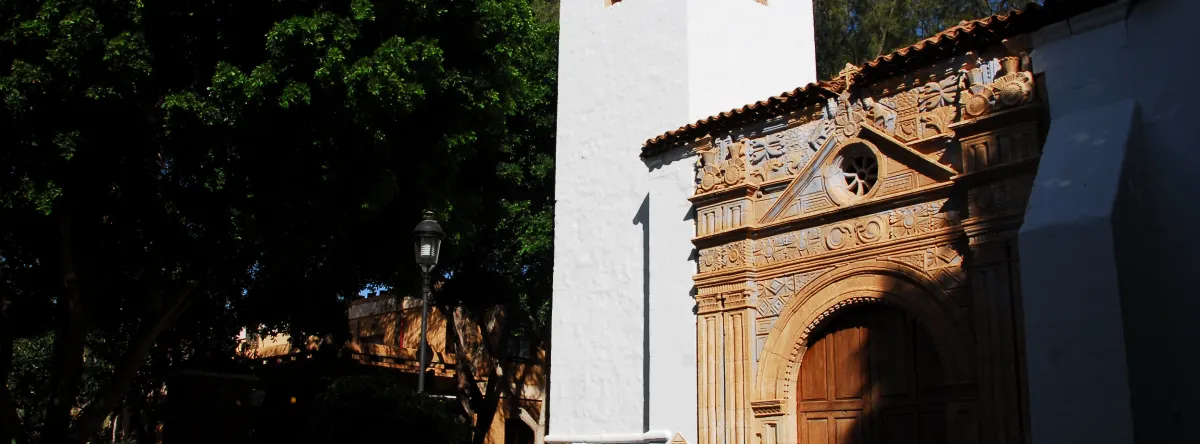
The Church of Nuestra Señora de Regla is one of Fuerteventura’s most unusual religious buildings. It stands in the centre of Pájara and is known for its two-nave layout, decorated doorway and surviving stonework details. It was declared an Asset of Cultural Interest in the Monument category in 1986.
Its interest lies both in the architecture and in the place it occupies within the island’s history. Pájara was once an important inland centre, and its church shows how religious architecture adapted to local materials, resources and building methods. It is a short visit, but it adds useful context to the historic heritage of southern Fuerteventura.
3. Salinas del Carmen salt pans
The Salinas del Carmen salt pans are part of Fuerteventura’s coastal heritage. Set beside the sea, close to Caleta de Fuste, they preserve the link between salt production, the shoreline and a trade that once played an important role in everyday life on the island.
The site shows how sea salt was traditionally produced: seawater entered the salt pans, evaporated in the sun, formed crystals and was then collected by hand. The Salt Museum adds further context and makes this an accessible, visually clear stop with a strong connection to Majorero industrial heritage.
4. Traditional windmills and molinas
Traditional windmills and molinas, a later and lighter type of island mill, are a familiar sight in Fuerteventura’s rural landscape. For centuries, wind power was essential for grinding grain and was closely tied to cereal crops, gofio and rural life.
Restored or preserved examples can be found across the island, with sails, whitewashed walls and silhouettes that stand out against the bare terrain. Traditional windmills tend to be sturdier in structure, while the molina came later and is lighter and more practical. Including them in this guide brings a more everyday side of the island’s heritage into the journey.
Fuerteventura’s windmills are a reminder of how important wind once was for milling grain.
5. La Entallada lighthouse
La Entallada lighthouse, in the municipality of Tuineje, stands on one of the most striking points of Fuerteventura’s eastern coast. The building is unusual among Canarian lighthouses, with reddish stone, geometric lines and a strong presence on the cliff edge.
The road up to the lighthouse is part of the experience. It climbs towards a raised area with open views of the ocean and the surrounding arid scenery. The lighthouse recalls navigation, maritime surveillance and the island’s relationship with the Atlantic, but it is also one of the most memorable sights in this part of Fuerteventura.
Among Fuerteventura’s lighthouses, La Entallada stands out for its reddish stone architecture and its position above the eastern coast.
6. Punta Jandía lighthouse
Punta Jandía lighthouse stands at the southern tip of Fuerteventura. Getting there takes you across open, arid terrain exposed to the wind, with tracks, wild coastline and a real sense of reaching the island’s edge.
The lighthouse was built as a navigational aid, although much of the appeal comes from the setting. This part of southern Fuerteventura is defined by open sea, bare land, changing light and a largely undeveloped coast. It is one of the best stops on a route through Jandía.
7. Montaña Tindaya
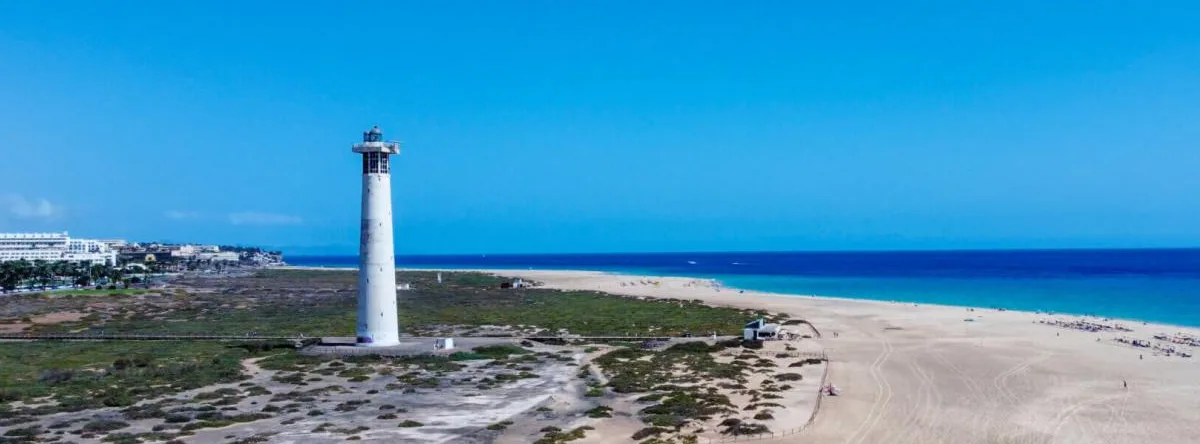
Tindaya rises clearly from the landscape of northern Fuerteventura, with an isolated outline above the plain. It has significant archaeological value thanks to the foot-shaped rock engravings known as podomorphs, which are attributed to the island’s Indigenous population.
Any visit should be approached with respect for the surroundings and for the mountain’s cultural value. Tindaya belongs to Fuerteventura’s Indigenous heritage and adds a place where landscape, history and geology meet in a very direct way.
8. Caldera de Gairía
Caldera de Gairía is an ancient volcanic cone in central Fuerteventura, near Tiscamanita and Casillas de Morales. Its conical shape stands out against the open inland landscape and clearly shows the volcanic origin of this part of the island.
Its interest is both geological and scenic. Around the caldera, plains, farmland and arid areas show how traditional agriculture developed alongside volcanic terrain. It is a good stop for getting a clearer sense of Fuerteventura’s landforms without moving too far from routes through the centre of the island.
9. Cuchillos de Vigán
The Cuchillos de Vigán are narrow, elongated ridges in eastern Fuerteventura, set among ravines, arid slopes and areas close to the coast. Their name comes from the sharp, blade-like shape of the terrain, which looks like knives running across the landscape.
Their geological interest lies in the way erosion has shaped ancient volcanic materials over thousands of years. The result is a dry, rugged and highly recognisable landscape, where mountains, ravines and ocean create one of the most distinctive views of eastern Fuerteventura.
10. Malpaís de la Arena
Malpaís de la Arena is a lava field in northern Fuerteventura, near La Oliva. It is made up of lava flows, cones and dark, uneven surfaces created by relatively recent eruptions in the island’s geological history.
This natural monument reveals the volcanic character of northern Fuerteventura. The rough ground, black rock and vegetation adapted to arid conditions make it a very different stop on a route through Fuerteventura’s monuments.
After a day exploring Fuerteventura’s heritage, staying in Jandía is a perfect way of ending the day by the sea. The south of the island makes it easy to balance Majorero heritage with time on the coast.
In this area, you will find IFA Altamarena by Lopesan Hotels and IFA Villas Altamarena, two Lopesan Group properties in Jandía. From there, you can continue through southern Fuerteventura, visit Punta Jandía lighthouse or keep another day free for the Fuerteventura monuments you would rather explore at a slower pace.