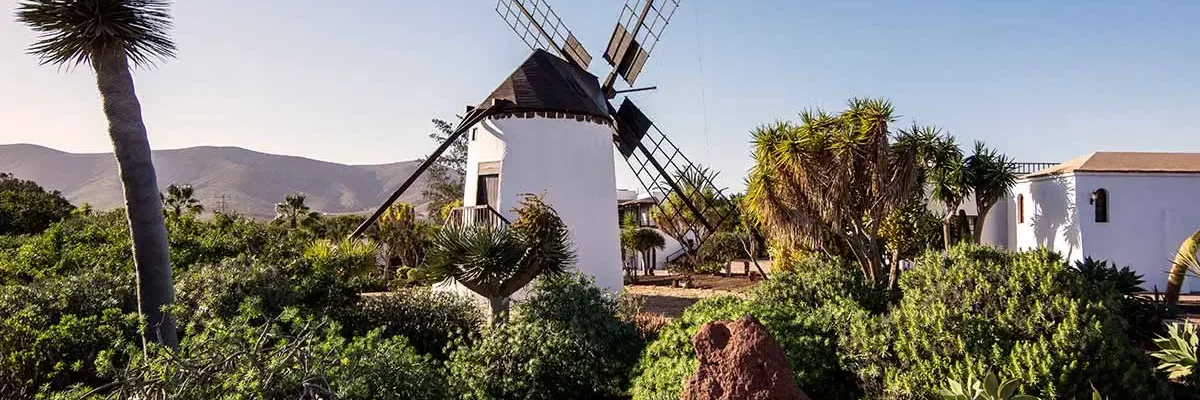
Fuerteventura is sunshine, wind and wide-open landscapes. An island of contrasts, with endless beaches, quiet villages and a light that captivates both locals and visitors. But it is also an island of history – much of it told through the windmills that dot the scenery.
If you’d like to discover a different side of the island, the windmill route of Fuerteventura takes you past some of the most emblematic structures from its farming past. Simple constructions that have endured through time, now woven into the island’s cultural heritage.
Origins and heritage of Fuerteventura’s windmills
The windmills of Fuerteventura are not mere decoration – they were once essential tools on an island where the wind was more ally than obstacle. For centuries, these ingenious machines ground grain or drew water, closely tied to the island’s agricultural life.
Today, more than a thousand still stand, though some of the most remarkable are in La Oliva, Villaverde, Tefía and Tiscamanita. Many have been restored and are now symbols of local heritage. Some remain untouched, while others have been adapted to show how they worked and the role they played in daily life.
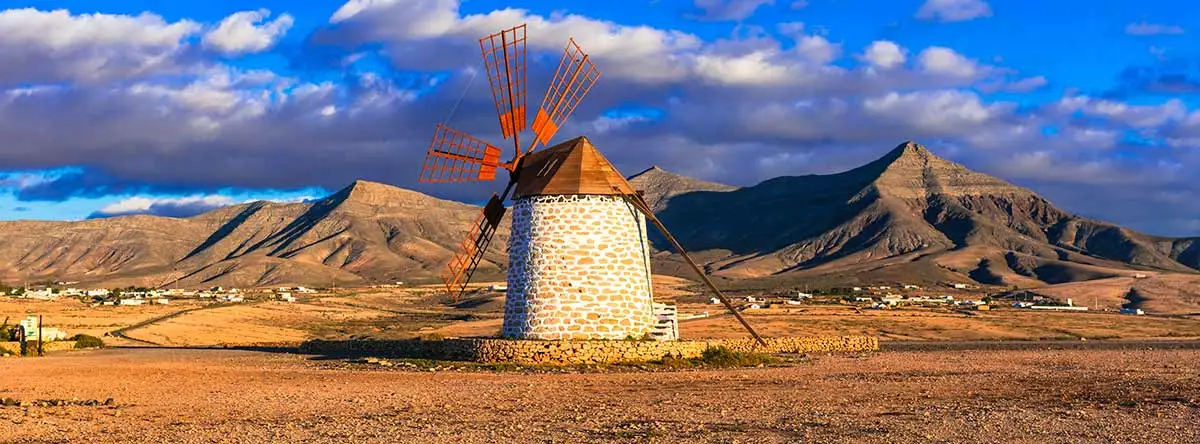
Most have a circular base, a conical roof and between four and six sails. Built from simple, durable materials to withstand the constant winds, many include a system to turn the sails in line with the breeze – a clever adaptation to the environment that still impresses.
Together, they form the so-called windmill route of Fuerteventura, a journey across different points of the island that offers a glimpse into a vital part of its agricultural past. An itinerary best enjoyed at an easy pace.

Architecture and design of Fuerteventura’s windmills
These windmills show how traditional architecture adapted to the island’s environment and the needs of its people. Their design reflects both climate and function, resulting in structures that are sturdy and efficient.
Their circular bases were built from volcanic stone and lime mortar – abundant local materials that gave strength and stability. Above this, a conical roof protected the interior and allowed the wind to act directly on the sails.
The sails, usually made of wood, came in sets of four or six depending on the mill. Their size and design were calculated to harness the force of the trade winds. Many mills also had mechanisms to turn the sails towards the prevailing wind – simple yet ingenious systems that ensured smooth operation.
Different mills had different uses: some ground cereals into flour or gofio, while others pumped water for irrigation or household use.
The restoration of several examples has preserved these architectural and technical details, keeping alive a tradition that links the island’s present to its farming past. Compared with the windmills of regions such as La Mancha, those of Fuerteventura are smaller and more robust, designed to withstand the island’s particular winds and climate.
A practical route: the mills of Villaverde, Tefía and the Interpretation Centre of Tiscamanita
The windmill route of Fuerteventura has three key stops that showcase some of the best-preserved and most iconic examples on the island.
The windmills of Villaverde
Located near Corralejo, in the municipality of La Oliva, this group of mills is an excellent starting point. Set on a hillside, they were used mainly for grinding grain. Their four sails captured the wind to produce flour and gofio, staples of the local diet.
Tefía windmill
Around twenty minutes’ drive from Villaverde, in the village of Tefía, stands one of the most distinctive mills. Built in 1930, it has six sails, making the grinding process easier. Recently restored, it is well preserved and part of the local heritage. Nearby, the La Alcogida Museum and the Hermitage of San Agustín are well worth a stop if time allows.
The Interpretation Centre of Tiscamanita
The final stop is the Interpretation Centre in Tiscamanita. Housed in a refurbished mill, it opens from Tuesday to Saturday and offers an engaging insight into how these traditional machines worked and their importance to the island. Admission is modest, and visitors can even try their hand at grinding grain.
Where to stay while exploring the windmill route
Southern Fuerteventura is an excellent base for discovering the island’s windmills without giving up comfort and good service. Lopesan Hotel Group offers two options that combine quality, location and a relaxed atmosphere.
Our IFA Altamarena Hotel in Morro Jable is perfectly located for beach days, relaxation and cultural outings across the island. Its setting and services make it the ideal complement to a tour of Fuerteventura’s windmills and other attractions.
For those seeking more privacy and space, IFA Villas Altamarena offers exclusive villas with sea views and direct beach access. A perfect way to enjoy the island at your own rhythm, without compromising on quality or comfort.
Both are excellent bases for exploring the island at leisure and returning each evening to a place where you can recharge. A simple, welcoming way to experience Fuerteventura.
The windmill route of Fuerteventura is an invitation to explore a past that still lives on in the island’s landscapes and culture. A gentle journey that connects you with its traditions and its people. After a day visiting these guardians of the wind, relaxing in a good hotel in Morro Jable is the perfect way to recharge and keep discovering the island. We look forward to welcoming you!