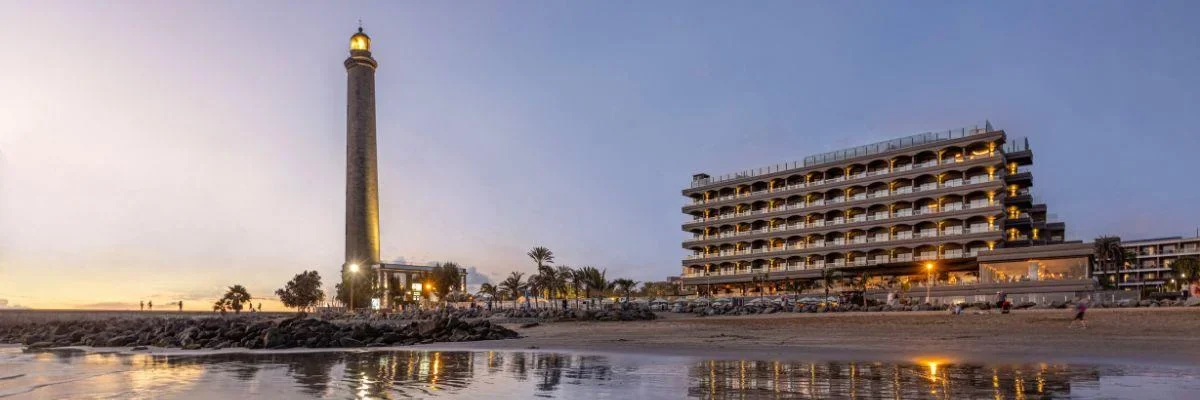
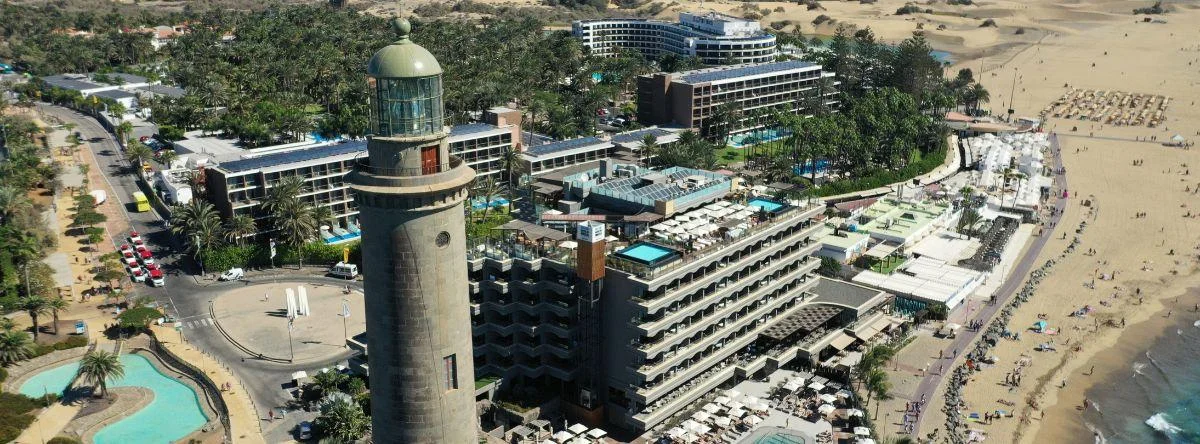
It stands at the southernmost tip of Gran Canaria, as if from a remote and solitary landscape: the Maspalomas lighthouse. Discover the history and cultural wealth of the island through this lighthouse and its cultural jewel, the Ethnographic Centre, supported by the Foundation for the Ethnography and Development of Canarian Crafts (FEDAC).
History of Faro de Maspalomas (Maspalomas Lighthouse)
The construction of the Maspalomas lighthouse was an ambitious project that required the collaboration of engineers, architects, workers and craftsmen from all over the island. The idea of building a lighthouse on the southern tip of Gran Canaria was first mooted in 1861, but construction did not begin until 1884.
The project was entrusted to the engineer Juan de León y Castillo, who designed an eclectic lighthouse 56 metres high. The construction was made of greenish-grey Fataga basalt, a typical stone of the island, characterised by its hardness and resistance.
The work took five years, until 1889. During this time, the workers had to face several challenges, such as the difficult access to the site, the dry climate and the lack of resources. However, thanks to their hard work and dedication, the Maspalomas lighthouse was inaugurated on 1 February 1890.
The lighthouse quickly became a symbol of the island and a landmark for sailors. Its construction also boosted the economic development of the area, attracting new visitors and businesses.
Today, the Maspalomas lighthouse is one of Gran Canaria’s most emblematic monuments. In addition to its original function, the lighthouse also houses the Maspalomas Ethnographic Centre, a museum dedicated to the island’s culture and traditions.
Architectural description
Since its opening in 1890, this site has witnessed many historic events and has undergone several renovations and improvements. Here are some of the most significant:
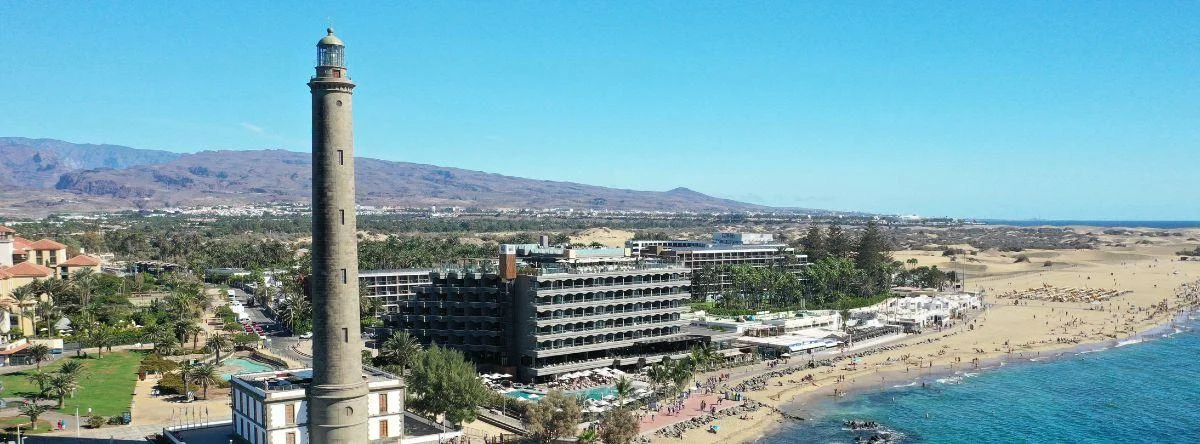
Meticulous design: The Maspalomas lighthouse, built under the direction of the engineer Juan de León y Castillo, is an architectural landmark on the south coast of Gran Canaria. From the outset, the lighthouse was designed to blend in with its surroundings, so a dune free site was chosen, with a solid sandstone foundation, just 2.20 metres above sea level.
Carefully planned proportions: Carefully planned proportions: The lighthouse stands on an esplanade 35 metres wide and 36.50 metres long. The lighthouse keeper’s house, which is rectangular in plan, and the tower, which is circular, are harmoniously intertwined. The house occupies the façade facing the sea and the land, while the tower stands in the middle, creating a balanced fusion between the two architectural bodies.
A blend of styles: The architectural richness of the lighthouse is expressed in the harmonious combination of two basic elements: the lighthouse keeper’s house, which has a quadrangular plan and is decorated with blue masonry, and the imposing truncated cone tower, built in blue masonry, forming an eclectic ensemble that reflects the rich cultural heritage of Gran Canaria.
Details: The façade of the Faro de Maspalomas stands out for its refined details in blue stonework, such as the recessed openings with curved lintels, mullioned windows and corner bosses. The elegance is further enhanced by the use of tea wood and wrought iron in the openings, staircase, ceilings and floors, giving the building a noble and distinguished appearance. In addition, the patio, decorated with floral and geometric tiles, creates a welcoming space that complements the architectural majesty of the lighthouse.
Modernist west façade: The west façade is a focal point with a false balcony on the first floor, imitating the modernist typology. The main north-facing doorway, raised on two blue stone steps, provides access from the surrounding square.
The lighthouse keeper’s house and its function: In addition to its practical function, the lighthouse keeper’s house serves as a base for the tower, acting as a buttress and absorbing its thrust. A small quay or jetty connects the building to the sea, facilitating the unloading of materials and avoiding the complicated journey by road.
Tower: The tower, a truncated conical cylinder of bluestone, stands on the south side. The decorative masonry elements, such as the plinth, fascia, cornice and mouldings, extend up to the tower, enhancing its structure. The classic design of the tower, with a tapering shaft and a capital topped with rings and motoles, makes it visually imposing.
In short, you will find a unique combination of functionality and aesthetics that will forever be remembered as a representative symbol of Gran Canaria’s cultural heritage.
Cultural value of the centre
The Maspalomas lighthouse is an architectural and cultural symbol of Gran Canaria. In addition to its original function, the lighthouse houses the Maspalomas Ethnographic Centre, a museum dedicated to the culture and traditions of the island.
The Faro de Maspalomas Ethnographic Centre has a collection of more than 5,000 ethnographic objects that reflect the daily life of the Canarian people over the centuries.
The collection includes traditional costumes, agricultural tools, musical instruments, household objects and other items that testify to the richness and diversity of Canarian culture.
It also offers a wide range of activities and exhibitions that allow you to learn about Canarian culture in a fun and interactive way. Thematic exhibitions focus on the history, crafts, music and gastronomy of the island. The educational programmes offer children and adults the opportunity to get to know Canarian culture through workshops, guided tours and workshops. Canarian culture through workshops, guided tours and other activities.
The Ethnographic Centre is an important cultural institution that contributes to the preservation and dissemination of Canarian culture. The centre is a popular destination for visitors of all ages and offers a unique opportunity to learn about the history and culture of Gran Canaria.
Useful information about the Maspalomas Lighthouse Ethnographic Centre
When planning your visit to the Ethnographic Centre, check the opening hours and book in advance, as the maximum group size is 15 people. You have the option of hiring a guided tour, which will give you a much more detailed explanation of each exhibition and tell you fascinating anecdotes about the history of the lighthouse.
The Ethnographic Centre also organises special events and activities, such as talks and workshops, to enrich the visitor’s experience.
If you want to discover the true essence of Gran Canaria, we invite you to visit the Maspalomas Lighthouse Ethnographic Centre. The unique architecture, the impressive landscape and the fascinating stories it reveals will make this an unforgettable experience.
Enjoy the cultural wealth of the island!